.svg)


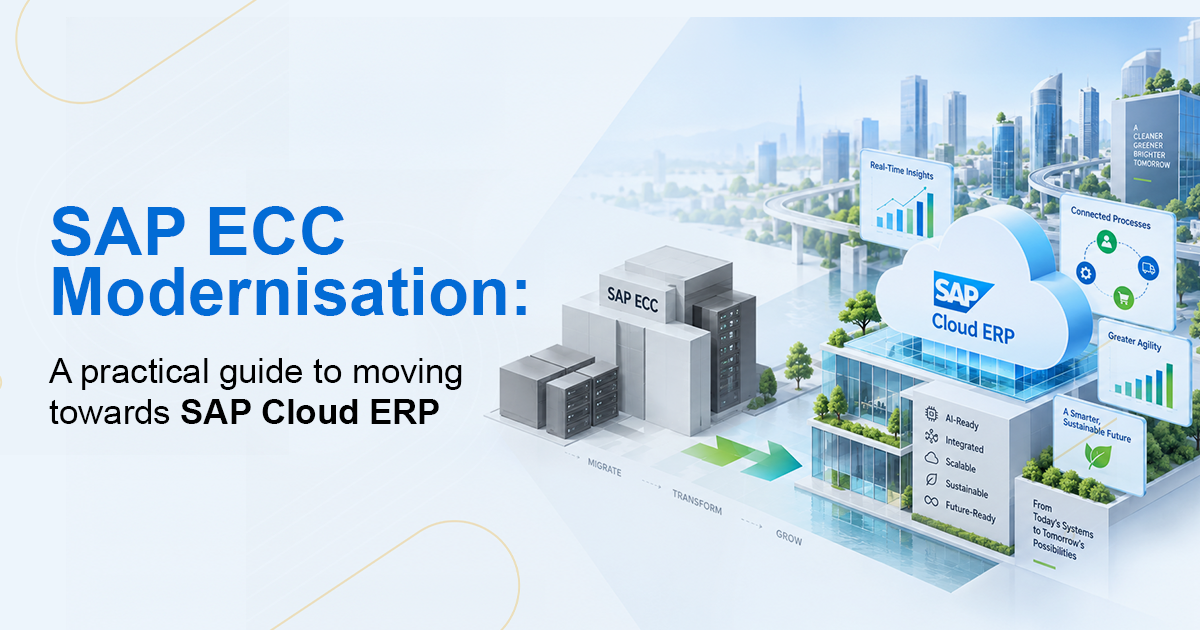
SAP ECC Modernisation: A Practical Guide to Moving Towards SAP Cloud ERP
Why the journey from SAP ECC can’t wait
- SAP ECC modernisation is becoming a strategic priority as businesses face changing processes, integrations, data requirements, and SAP maintenance timelines.
- A successful transition requires assessing customizations, data, integrations, processes, and AI readiness before selecting the right modernisation approach.
- Moving to SAP Cloud ERP can help organisations establish a more scalable foundation for automation, analytics, integration, and future business growth.
If your business has been running on SAP ECC for years, the question isn't really whether the system still works. It probably does. The bigger question is whether it can keep up as your processes, data, integrations, and technology needs change.
Years of custom code, legacy integrations and manual workarounds can make ECC environments increasingly difficult to change. At the same time, organisations are looking for greater automation, real-time insights, and AI-enabled processes.
SAP's mainstream maintenance for SAP Business Suite 7 core applications runs through the end of 2027, with optional extended maintenance available through 2030This gives organizations a defined window to assess their current landscape and plan their transition.
The case for modernization, therefore, is not only about maintenance. It is about determining whether the current ERP foundation can support the organization's next phase of growth, automation, and digital transformation.
The Cost of Staying on ECC Is Not Limited to Maintenance
Consider an organisation that has operated SAP ECC for more than a decade. Over time, it may have introduced custom reports, bespoke workflows, modifications to standard processes, interfaces with third-party applications, and integrations with systems added through acquisitions.
Each change mayhave solved a legitimate business requirement at the time. The effect, however, can be significant.
A seemingly straightforward business change may require an impact assessment across custom code and integrations. A new reporting requirement may depend on data being extracted into a separate analytics layer. An acquisition may require another set of interfaces between ERP environments. An automation initiative may be difficult because the underlying process is heavily customized.
The result is an unfamiliar pattern: IT spends increasing effort maintaining the existing environment while business teams wait longer for change.
This is one of the reasons ERP modernisation should be evaluated in terms of business agility, not just infrastructure.
Organizations should examine whether:
- New locations, products, acquisitions, or business models are exposing process limitations.
- Changes require significant development effort or lengthy testing cycles.
- IT resources are increasingly focused on technical debt and systemmaintenance.
- Business users depend on spreadsheets or manual workarounds for criticalprocesses.
- Real-time operational and financial visibility is difficult to achieve.
- Customisations make upgrades, integrations, or process changes morecomplicated.
- Data inconsistencies limit analytics and automation initiatives.
- Existing processes make it difficult to introduce AI-supported workflows.
- Multiple ERP or non-SAP systems require extensive integration effort.
If several these conditions exist, the business case for modernisation extends well beyond SAP ECC support dates.
The question becomes whether continuing to invest in the existing architecture is moreappropriate than redirecting that investment towards a modern ERP platform.
ERP Modernisation Is Also a Process Decision
Moving from ECC to SAP Cloud ERP is not simply a matter of transferring existing transactions and customizations into a new environment.
The transition creates an opportunity to examine which processes should be retained, whichshould be simplified, and which should be redesigned.
This is particularly important because years of customisation can hide the difference between a genuinely necessary business requirement and a workaround that created because of historical system limitations.
For example, an organisation may have a customised approval process for procurement because its original ERP environment could not accommodate a particular business rule easily. During modernisation, the organisation can reassess whether that requirement still exists and whether it can now be addressed through standard capabilities.
SAP Cloud ERP isdesigned around preconfigured business processes and industry best practices, with embedded analytics and AI capabilities across core areas includingfinance, supply chain, and procurement.
For organizations with extensive ECC customisation, this can create a valuable opportunity to reduce unnecessary complexity before it becomes embedded into the next generation of the ERP landscape.
AI Changes What Organisations Should Expect From ERP
AI is changing the ERP modernization conversation. Historically, ERP systems were primarily designed to record transactions and provide structured information for business processes. Modern ERP environments are increasingly expected to use that information to automate work, identify patterns, support decisions, and provide contextual assistance.
That raises a fundamental requirement: AI needs reliable business context.
Consider an organisation trying to implement an AI-based forecasting capability while its customer, material, supplier, and transactional data is inconsistent across multiple systems.
The problem is not necessarily the AI model. The problem is the underlying enterprise data and process architecture.
Similarly, an organization cannot easily automate an end-to-end procurement process if supplier information, approval rules, purchasing data, and downstream financial processes remain fragmented.
SAP Cloud ERP provides embedded AI capabilities intended to automate tasks, predict outcomes, and support decision-making across finance and supply chain processes.
SAP's current cloud ERP positioning also highlights more than 200 embedded intelligence scenarios and automation within standard workflows as part of its broader value proposition.
For an organisation moving from ECC, the implication is significant. The objectives should not be to migrate the old ERP first and think about AI later. The transformation should consider data quality, process standardization, integration, governance, analytics, and automation as part of the target architecture.
Vestrics' SAP Business Technology Platform practice supports this broader architecture through data and analytics, application development, workflow automation, integration, API management, and AI capabilities.
This becomes particularly relevant when an organisation needs to connect SAP Cloud ERP with existing applications, third-party systems, or specialised business solutions rather than replacing its entire technology landscape.
From ECC to Cloud ERP: What Should the Business Evaluate First?
A successful modernization program starts with evidence. Before deciding between a brownfield conversion, a greenfield implementation, or another transition path, organizations need to understand their current SAP environment. That assessment should cover more than technical compatibility.
1.) Process assessment
Which business processes are standard? Which are heavily customized? Where do manual workarounds exist? Which processes create the most operational friction?
2.) Custom code assessment
Which custom developments are still actively used? Which are business-critical? Which can be retired or replaced by standard capabilities?
3.) Data assessment
What master data requires cleansing? Which historical data needs to be migrated? Are there duplicates, inconsistent structures, or obsolete records?
4.) Integration assessment
Which third-party applications connect to ECC? Which interfaces are business-critical? What should be retained, redesigned, replaced, or moved to a modern integration architecture?
5.) Business readiness
Are process owners aligned on the target operating model? Are users prepared standardized processes? Is there sufficient governance for decisions around scope and customisation?
Planning Early Creates More Strategic Options
Waiting for the maintenance deadline can turn ERP modernization into a compressed technicalprogramme.
Starting earlier allows organizations to treat it as a business programme.
There is time to assess the existing landscape, establish the business case, determine the appropriate transition approach, clean data, review customizations, redesign processes, prepare users, and sequence integrations.
It also creates room to decide what should happen to the broader SAP landscape.
For example, SAP Business Technology Platform can provide integration, application development, automation, analytics, and data capabilities around the ERP core.
SAP Analytics Cloud can support reporting, planning, forecasting, and scenario modelling across business functions and can integrate with SAP S/4HANA, SAP SuccessFactors, SAP Integrated Business Planning, and third-party data.
This means the target architecture does not have to be limited to “ECC replacement.”
It can become an opportunity to establish a more coherent enterprise architecture around ERP, data, analytics, integration, automation, and AI.
A Structured Path From SAP ECC to SAP Cloud ERP
The transition should ultimately be governed by business priorities rather than the migration deadline alone.
At VestricsSolutions, we structure SAP modernisation around the organization's starting environment and target outcomes.
The first step is understanding the existing landscape through readiness and process assessment.This provides the basis for deciding whether a greenfield or brownfield approach is appropriate and identifying the areas that require remediation before migration.
The next stageinvolves defining the target processes, data strategy, integration requirements, customization approach, and implementation roadmap.
For data, this can include cleansing, classification, transformation, migration, and validation. For integrations, the focus can extend beyond simply recreating existing interfaces towards establishing a more maintainable architecture using modern integration capabilities.
For organizations with significant process complexity, business process re-engineering can run alongside the technical migration so that inefficient legacy processes are simply carried into the new environment.
Implementation then needs to be supported by structured testing, user enablement, cutover planning, and post-go-live support.
Start With the Current State, Not the Deadline
SAP ECC has supported organizations through years of growth, expansion, and operational change. For many businesses, the challenge is not abandoning what works. It is determining what should be carried forward and what needs to change.
That requires a structured assessment of processes, custom code, data, integrations, users, and business requirements.
SAP's maintenance roadmap gives organizations a defined planning horizon, with mainstream maintenance for SAP Business Suite 7 core applications through the end of 2027 and optional extended maintenance through the end of 2030.
But the stronger reason to start planning now is control.
Early planning gives organizations more time to evaluate the business case, select an appropriate transition approach, reduce unnecessary customization, prepare data, redesign processes, and build the capabilities required for analytics, automation, and AI.
At VestricsSolutions, we help organisations approach SAP modernisation from that broader perspective—combining readiness assessment, migration and upgrade, SAPS/4HANA implementation, data migration, business process re-engineering, SAPBTP, integration, analytics, customisation, and application management.
If your organization is running SAP ECC and evaluating its path to SAP Cloud ERP, Vestrics Solutions can help assess your current landscape, identify transformation priorities, and build a practical migration roadmap. Book a consultation with our SAP experts to start with the current state and plan the transition around your business objectives.
FAQs
1. How should a business assess its SAP ECC environment beforemodernisation?
Start by reviewing the current ERP landscape, including custom code, integrations, data quality, business processes, system dependencies, and areas where users rely on manual workarounds. This helps establish the complexity and priorities of the transformation.
2. What happens to existing SAP ECC customisations during modernisation?
Existing customizations should be assessed individually rather than automatically carried forward. Businesses can determine which developments remain essential, which can be replaced by standard SAP capabilities, and which can be retired.
3. How does data quality affect an SAP ECC migration?
Poor-quality or inconsistent master data can increase migration effort and create problems in new ERP environment. Data cleansing, classification, mapping, and validation should therefore be addressed before and during migration.
4. What role do integrations play in SAP ECC modernisation?
Integrations should be reviewed to determine which interfaces are still required and whetherthey should be redesigned using a modern integration architecture. This is particularly important when ECC connects with third-party applications,acquired systems, analytics platforms or other enterprise solutions.
5. Should businesses migrate to SAP Cloud ERP before introducing AI?
AI does not necessarily need to wait until after ERP modernisation, but its effectiveness depends heavily on the underlying data, processes, and technology architecture. Organizations should therefore consider AI readiness as part of the ERP transformation rather than treating it as a completely separate initiative.
Recommended Blogs


Fuel Your Business Transformation with Our Insights
Bookmark this page for regular updates and explore how our expertise can accelerate your
transformation journey.