.svg)


The 2027 Countdown: Why Waiting to Migrate from SAP ECC is Your Biggest Financial Risk
The 2027 Countdown: Why Waiting to Migrate from SAP ECC is Your Biggest Financial Risk
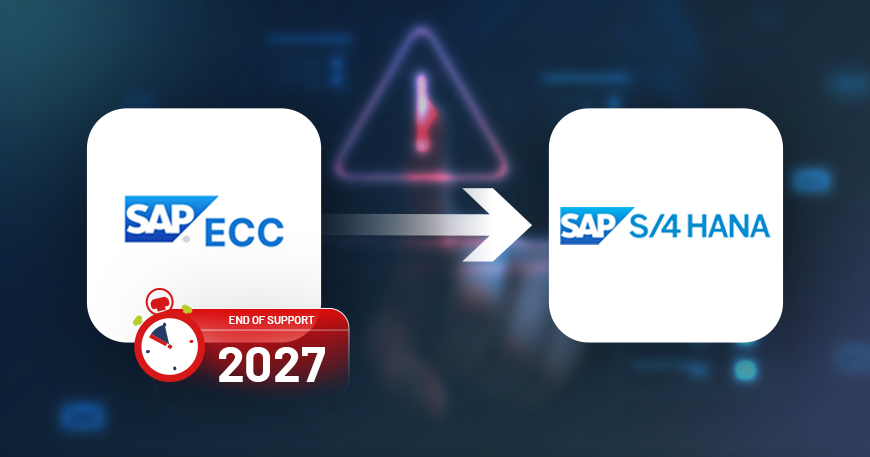
- The SAP ECC end of support 2027 deadline is approaching quickly. Organizations running ECC must evaluate how continued reliance on legacy systems will affect support costs, compliance requirements, and long-term operational stability.
- Delaying SAP ECC to S/4HANA migration gradually increases financial pressure through rising maintenance fees, consulting cost inflation, growing technical debt, and slower adoption of automation and analytics capabilities.
- Planning a phased SAP ECC migration to S/4HANA now allows businesses to manage risk carefully, control transformation costs, and modernize their ERP landscape without disrupting core operations.
Enterprise Resource Planning systems are central to modern business operations. Financial reporting, procurement, supply chain planning, compliance management, and operational analytics all depend on the stability and reliability of this core platform.
For more than two decades, SAP ECC has supported enterprise processes across industries. However, SAP has already established a clear end-of-support timeline for the platform, prompting organizations to reassess their long-term ERP strategy.
Recent industry research highlights how significant this shift has become. Nearly 57% of organizations cite the impending end of maintenance for SAP ECC and the broader SAP Business Suite as the primary driver for migration initiatives. In addition, 48% of organizations identify the approaching support deadline as one of the most influential external factors shaping their SAP S/4HANA plans over the past year.
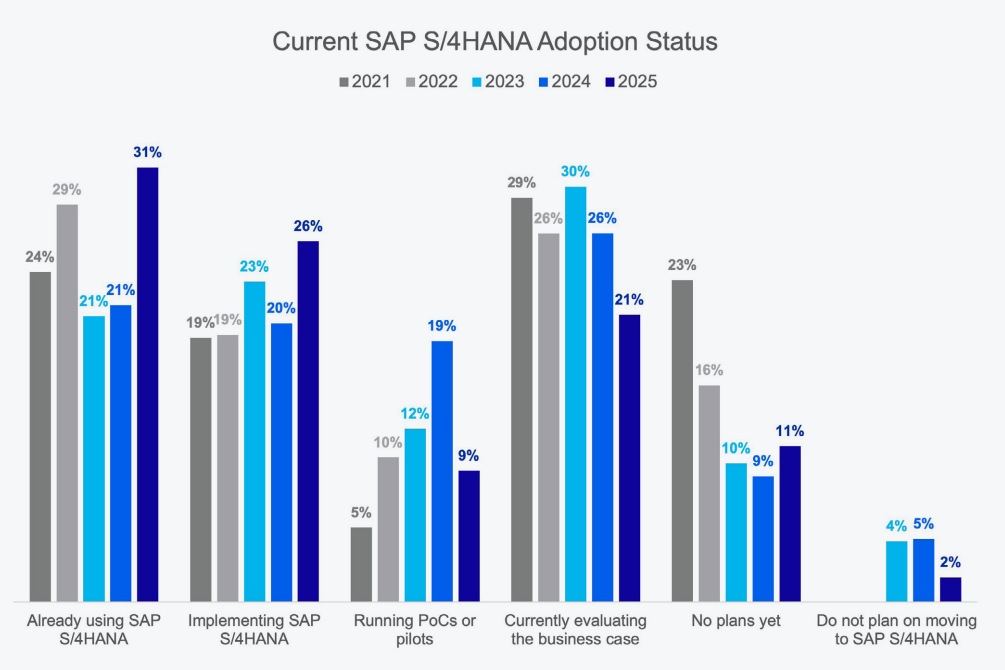
Image Credit- sapinsider
SAP ECC to S/4HANA Migration Risks Before 2027
SAP has confirmed that mainstream maintenance for SAP ECC 6.0 and SAP Business Suite 7 ends on 31 December 2027, with only paid extended maintenance available until 2030. After these dates, organizations will lose standard SAP support, security patches, and legal or regulatory updates, while costs to keep ECC running safely and compliantly rise sharply.
This makes 2027 a hard stop for the business model built on ECC. It directly affects how much organizations spend on compliance, how much operational risk they carry, and how quickly they can adopt modern capabilities such as automation, AI, and real-time analytics.
Organizations that delay SAP ECC to S/4HANA migration are not simply postponing a project; they are gradually increasing operational risk and financial pressure.
For a step-by-step view of how to structure your S/4HANA journey ahead of the 2027 deadline, check our SAP S/4HANA migration guide.
Key SAP ECC Support Milestones
Enterprise software lifecycles typically follow a predictable pattern that includes mainstream maintenance, extended maintenance, and eventually limited or customer-specific support. SAP ECC follows the same lifecycle model.
Some dates are extremely important to know in “2027” because they’ll define how long you can realistically stay where you are without paying a premium or taking on unacceptable risk.
Understanding these milestones helps organizations assess the SAP ECC end of support impact and plan their SAP ECC to S/4HANA migration strategy.
a.) Mainstream Maintenance – Until 31 December 2027
During this phase, SAP provides full support coverage including:
- Security patches
- Legal and regulatory updates
- Bug fixes and technical support
- Product improvements and enhancements
This phase represents the most stable and cost-effective operating environment for ECC customers.
b.) Extended Maintenance – 2028 to 2030
Organizations that continue operating ECC after 2027 can purchase extended maintenance. However, this phase introduces several limitations:
- Additional support surcharges
- Limited innovation updates
- Reduced enhancement capabilities
- Dependency on older technology stacks
Although extended maintenance allows companies more time, it increases operational costs without delivering meaningful new functionality.
c.) Post-2030 Support Scenario
After 2030, ECC effectively transitions into customer-specific support, which means:
- No standard SAP security updates
- No legal or regulatory updates
- Limited product support
- Higher internal responsibility for system maintenance
This dramatically increases the SAP ECC end of support impact, especially for companies operating in regulated industries.
Why “Wait and See” Often Becomes an Expensive Strategy
Many ECC customers are still sitting on the fence, assuming 2027 is far enough away to postpone big decisions. Industry data shows that a significant share of SAP ECC customers still has no defined migration plan. But that inertia comes with hidden financial penalties.
The risks of delaying SAP ECC migration typically appear across three areas:
- Higher run costs for ECC as maintenance fees rise.
- Higher change costs when you finally move, due to resource scarcity and technical debt.
- Higher risk costs via security exposure, downtime, and compliance issues that can translate into fines or reputational damage.
So even if you are not writing a cheque labeled “2027 penalty,” your total cost of ownership (TCO) is quietly increasing every year you push the decision out.
Related: Read our blog to explore why forward-looking businesses are migrating from ECC to S/4HANA Cloud, and how this shift drives long-term competitiveness.
SAP ECC vs SAP S/4HANA
Before examining the operational risks of delaying migration, it is helpful to understand how SAP ECC differs from SAP S/4HANA at a technical and architectural level.
Direct Risks of Delaying SAP ECC Migration
1. Premium SAP Support and Extended Maintenance
Once the SAP ECC end of support 2027 deadline passes and ECC moves out of mainstream maintenance, you pay more for less. Extended maintenance for ECC EHP 6–8 comes with a surcharge on top of standard support, and provides only essential fixes and limited legal updates, but no new innovation.
Customer-specific maintenance after that is even more restrictive, often leaving you responsible for managing security and compliance gaps yourself. This is the worst kind of IT spend. Rising year-on-year yet generating no incremental business value.
2. Inflation in Migration and Consulting Rates
As the SAP ECC end of support 2027 date gets closer, demand for experienced S/4HANA consultants and migration partners' spikes, while supply remains limited. The consulting and migration costs can increase 30–50% in the 2026–2027 window, driven by “rush hour” demand and scarcity of seasoned resources.
Organizations that defer until the last two years have less leverage on pricing, fewer partner options, and more likelihood of accepting suboptimal project structures simply to hit the date. In other words, delaying SAP ECC to S/4HANA migration compresses your negotiation power while expanding your budget.
3. Technical Debt and Operational Overhead
Many ECC environments have evolved over the years. Custom developments, integrations, and workarounds accumulate over time. This creates what technology teams refer to as technical debt.
Older hardware and on-premises infrastructures demand more maintenance, patching, and monitoring effort, which translates to higher operational expenditure (OpEx). Highly customized ECC systems make even small changes complicated and expensive.
By contrast, S/4HANA and ERP cloud platforms simplify architecture, reduce customization complexity, and support standardized processes. Over time, this can reduce total cost of ownership significantly.
Indirect Costs of Delaying SAP ECC Migration
1. Security Vulnerabilities and Cyber Risk
Cybersecurity risk has become a board-level concern across industries. ERP platforms contain highly sensitive data, including financial records, supplier contracts, payroll information, and customer details.
Running an ERP platform beyond its mainstream support lifecycle increases exposure to security vulnerabilities.
After mainstream support ends, newly discovered security issues may not receive immediate patches. This creates potential entry points for attackers.
Legacy ERP systems often struggle with:
- Outdated authentication frameworks
- Older encryption protocols
- Unsupported third-party components
For organizations with large financial operations running on ECC, a major incident can create direct financial loss, lengthy downtime, and legal liability tied to data protection regulations. This board-level risk can materially impact market valuation.
2. Compliance and Regulatory Exposure
ECC has long been the backbone of financial reporting, tax, and statutory compliance. After SAP ECC end of support 2027, missing or delayed regulatory updates from SAP can lead to non-compliant reporting in areas like tax, e-invoicing, payroll, and ESG disclosures.
Rectifying non-compliance retroactively often involves interest, penalties, and expensive remediation projects that dwarf the cost of a planned migration.
For highly regulated sectors such as pharmaceuticals, utilities, and financial services, these risks alone can justify accelerating migration plans.
3. Operational Disruption and Downtime Risk
The later you start, the more you compress project timelines. Shorter project timelines reduce the depth and quality of testing, increasing the probability of post go-live issues, outages, and productivity loss.
Last-minute migrations force the business to accept compromises on scope, data quality, and change management, all of which carry downstream cost.
By beginning early, you spread cost over multiple financial periods and preserve enough time for design, testing, and stabilization without disrupting peak business cycles.
Opportunity Cost Loss by Staying on ECC
Remaining on ECC does not simply increase operational risk. It also limits access to modern ERP capabilities that your competitors may already be exploiting.
1. Lost Productivity and Automation Benefits
Organizations evaluating why migrate from SAP ECC to S/4HANA often cite productivity improvements as a key driver.
S/4HANA and SAP ERP Public Cloud bring embedded analytics, real-time reporting, and intelligent automation that ECC simply cannot match. Faster financial close, automated reconciliations, and predictive insights reduce manual effort and free up finance and operations teams for higher-value work.
Over a multi-year horizon, these gains translate into measurable headcount savings, reduced error rates, and better working capital management. Delaying migration means leaving these savings unrealized, which is a hidden drag on profitability.
2. Slower Innovation and Limited AI Adoption
Modern SAP roadmaps now focus on innovation on S/4HANA and cloud offerings, not ECC. New industry innovations, AI extensions, and integration capabilities are being delivered to these platforms.
ECC customers find it increasingly difficult to integrate new cloud applications, IoT platforms, and data services without complex bespoke interfaces. This slows down your ability to respond to market changes, launch new business models, or leverage AI for competitive advantage.
3. Competitive Positioning and Market Perception
Technology platforms increasingly influence how organizations are perceived by partners, investors, and customers. Modern ERP platforms demonstrate operational agility and technological maturity.
Organizations that are visibly stuck on aging ECC stacks risk being perceived as slow-moving, which can impact partnership opportunities and M&A attractiveness.
Conversely, early movers can promote their S/4HANA-enabled capabilities, such as real-time supply chain visibility or advanced analytics, as differentiators in RFPs and customer pitches. These capabilities are often a winning factor during partnerships or procurement discussions.
Related: Learn how Vestrics Solutions’ migration and upgrade services support readiness assessments, impact analysis, and TCO-focused planning for SAP ECC to S/4HANA migration.
Practical Steps to De-Risk the SAP ECC to S/4HANA Migration
You do not have to, and should not, jump straight into a big bang implementation. Instead, use the time before 2027 to de-risk, stage, and optimize your move.
Step 1: Assess Your ECC Landscape and Risk Profile
This step involves cataloging system instances, enhancement packages, custom code objects, integrations, and third-party add-ons. Special attention should be given to finance, tax, payroll, and regulatory reporting modules, as these areas typically carry the highest compliance exposure when support ends.
Step 2: Quantify the Cost of Delay
Organizations should quantify projected extended maintenance fees, infrastructure operating costs, consulting rate inflation, and cybersecurity exposure over the next three to five years. These projections can then be compared against the expected total cost of ownership (TCO) under S/4HANA or SAP ERP public cloud.
Step 3: Define a Phased Migration Strategy
In this stage, enterprises typically evaluate Brownfield system conversion, Greenfield re-implementation, or selective data transformation depending on customization levels and business transformation goals.
Step 4: Secure Strategic Partners Early
Engage with experienced S/4HANA migration partners before the market bottleneck fully hits. Consider fixed-price or outcome-based commercial models to contain budget risk.
Step 5: Invest in Data, Processes, and People
In parallel, start data cleansing and harmonization in ECC to reduce project complexity later. Rationalize customizations, favoring standard best practices unless there is a clear competitive justification.
2027 Is a Financial Deadline- And Vestrics Solutions Is Your Execution Partner
The SAP ECC end-of-support 2027 timeline is ultimately about how much risk your organization is willing to carry and how long you can afford to delay modernization in a market where speed, data, and automation are competitive weapons.
Partnering with Vestrics Solutions Pvt. Ltd., leading SAP Gold Partner in India, shifts this from a high-stakes gamble to a structured, de-risked roadmap, combining deep SAP expertise, industry-aligned solutions, and proven migration methodologies to S/4HANA and cloud.
Instead of simply racing the 2027 clock, Vestrics Solutions helps you phase your transition, optimize licenses, rationalize customizations, and build a future-ready architecture that starts delivering ROI even before cutover.
With experts guiding your assessment, planning, and execution, waiting to migrate until 2027 no longer feels like your only option, because you have a partner actively reducing cost, concentrating risk into manageable phases, and unlocking value that would otherwise remain trapped in legacy ECC.
Ready to turn 2027 from a risk into an opportunity? Connect with Vestrics Solutions Pvt. Ltd. today to start planning a safer, smarter, and faster move beyond SAP ECC.
FAQs
1. What is the difference between SAP ECC and SAP S/4HANA?
SAP ECC uses traditional database architecture with batch processing, while SAP S/4HANA uses an in-memory database that enables real-time analytics, simplified data models, and faster transaction processing.
2. How do companies choose between Brownfield and Greenfield migration?
Organizations select Brownfield migration to retain existing processes and data, while Greenfield implementation allows complete system redesign and process optimization for long-term digital transformation.
3. How long does SAP ECC to S/4HANA migration usually take?
Most SAP ECC migration to S/4HANA projects take between 12 and 24 months depending on system complexity, data volume, customization levels, and integration dependencies across the enterprise landscape.
4. What industries are most affected by SAP ECC end of support?
Industries with heavy regulatory requirements such as manufacturing, pharmaceuticals, utilities, financial services, and logistics are most impacted because their ERP systems manage compliance, reporting, and operational control.
5. Can organizations partially migrate to S/4HANA instead of a full transformation?
Yes. Some organizations adopt phased or selective data transformation approaches, migrating specific modules, subsidiaries, or business units first before completing the full enterprise-wide S/4HANA transition.
6. What happens if companies do not migrate from SAP ECC before 2027?
If companies do not migrate from SAP ECC before 2027, they move into paid extended maintenance. This support phase runs until 2030 for EHP 6–8 systems and provides limited security and legal updates, higher maintenance costs, no innovation updates, and increased compliance and cybersecurity risks.
7. Is SAP ECC still supported after 2027?
Yes, SAP ECC will remain supported after 2027 through paid extended maintenance until 2030 for EHP 6–8 systems, typically with an additional maintenance fee of around 2%. After 2030, support becomes customer-specific with limited coverage and no standard SAP updates.


Fuel Your Business Transformation with Our Insights
Bookmark this page for regular updates and explore how our expertise can accelerate your
transformation journey.