.svg)


What Is Clean Core in SAP and Why Is It Critical for Future ERP Upgrades?
- A SAP Clean Core architecture keeps SAP S/4HANA close to standard, minimizing risky custom code and tightly coupled integrations.
- It enables faster, safer ERP upgrades so you can consume SAP innovations, AI, and cloud capabilities continuously.
- Organizations that adopt a SAP Clean Core strategy report lower maintenance costs, better performance, and more predictable transformation programs.
A clean core in SAP means keeping your SAP S/4HANA system as close to standard as possible so upgrades stay fast, predictable, and low-risk. Instead of modifying the core with custom ABAP and hard-coded logic, you push innovation into governed extensions and the SAP Business Technology Platform (BTP).
For enterprise IT leaders, this SAP clean core architecture is becoming critical because it directly impacts upgrade timelines, innovation velocity, and total cost of ownership for the next decade of ERP transformation.
For organizations planning a transition to a SAP S/4HANA Clean Core, learn how structured transformation approaches can accelerate outcomes.
Explore our SAP S/4HANA implementation services
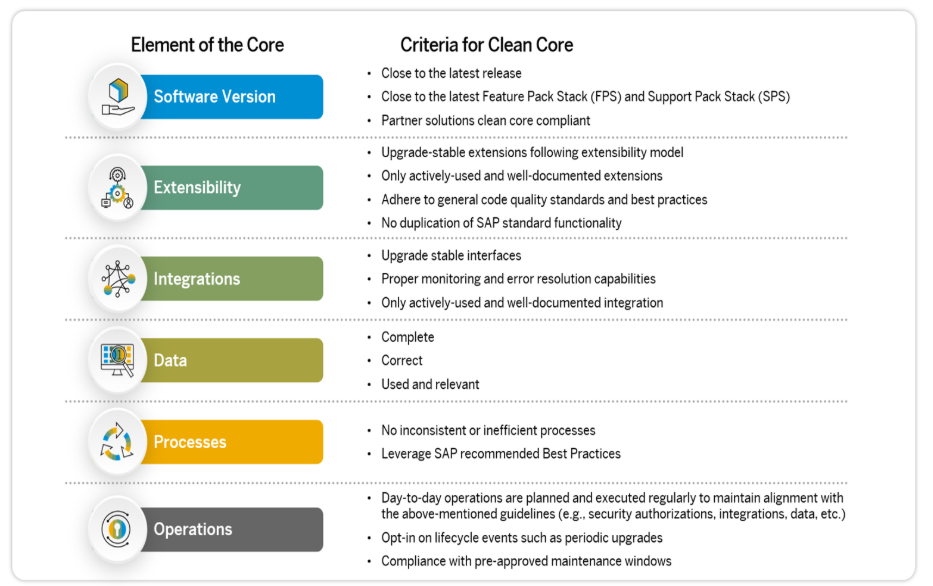
Image Credit- Community Sap
What is SAP Clean Core architecture?
SAP Clean Core architecture is a modernization model that keeps the digital core of ERP, particularly SAP S/4HANA, standard, upgrade-stable, and free from intrusive customizations. Instead of embedding business logic directly into the core via custom ABAP and table modifications, you design processes using configuration, standard best practices, and decoupled extensions.
From SAP’s own definition, a clean core is a set of guiding principles that support continuous transformation through fit-to-standard processes, trusted data, and decoupled integrations.
Core Components of SAP Clean Core Architecture
To understand how SAP clean core architecture works in practice, it is useful to look at its three foundational elements:
- Standardized business processes
Organizations align with SAP best practices rather than redesigning processes unnecessarily. This reduces complexity and improves scalability across business units.
- Clean and governed data
Reliable, structured data ensures that analytics, automation, and AI capabilities function effectively without inconsistencies.
- Decoupled integrations (API-first)
Systems communicate using APIs and event-driven architectures instead of tightly coupled interfaces, ensuring flexibility and resilience.
This structured model ensures that the ERP core remains stable while innovation happens outside it, making the SAP clean core approach both scalable and sustainable.
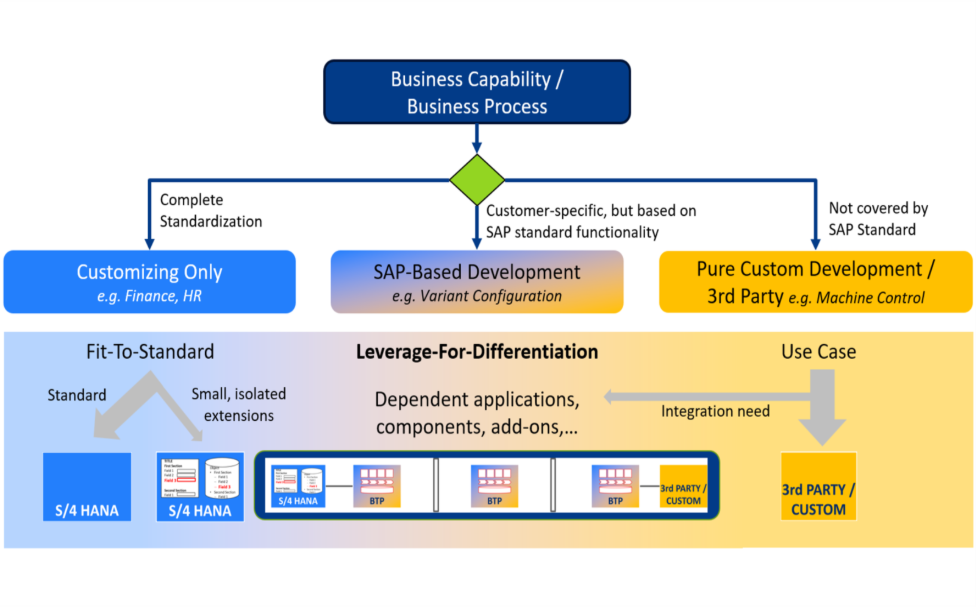
Approach for a SAP Clean Core Strategy
Image Credit- Community Sap
Key Principles of a Clean Core Strategy in SAP
To successfully implement a clean core strategy in SAP, organizations must shift their mindset from “customize everything” to “standardize and extend intelligently.”
Fit-to-Standard First: Instead of designing processes around legacy workflows, organizations align with SAP’s standard capabilities. This ensures that processes are aligned with industry best practices and remain upgrade-compatible.
No Direct Core Modifications: A defining aspect of SAP clean core architecture is the clear boundary between core and customization. Direct modifications to SAP’s core code are avoided, ensuring that upgrades remain predictable and stable. Enhancements are instead implemented through controlled extensibility models.
API-led, Loosely Coupled Integrations: Traditional SAP landscapes often relied on tightly coupled, point-to-point integrations, which created dependencies and increased upgrade risks. The SAP clean core approach replaces this with API-led integration, enabling systems to interact without being tightly bound to each other.
Strong Governance: Without governance, even the best clean core strategy in SAP can fail. Organizations must define what belongs in the core, what should move to extensions, and how custom developments are approved.
The clean core strategy in SAP does not prohibit customization; it reframes it so that the core remains clean, and custom innovation happens at the edges, not in the heart of the system.
Why is Clean Core important for SAP upgrades?
One of the most compelling reasons organizations adopt SAP clean core architecture is the direct impact it has on upgrade efficiency and risk reduction.
Historically, SAP upgrades have been among the most resource-intensive IT initiatives, often requiring months of planning, testing, and remediation. Much of this complexity stems from custom code embedded within the system core.
This is precisely why clean core is important for SAP upgrades as it eliminates the root cause of upgrade complexity.
How SAP Clean Core architecture accelerates upgrades
- Fewer retrofit cycles: When the core remains standard, each upgrade involves less impact analysis and remediation, so cycles shrink from months to weeks in mature clean core landscapes.
- Lower regression risk: Standard code plus governed extensions reduces the probability that an upgrade breaks critical processes.
- Faster adoption of innovation: New SAP S/4HANA features, AI, and analytics can be activated without redesigning tightly coupled customizations.
SAP itself positions SAP S/4HANA clean core as essential for cloud ERP delivery, where customers expect quarterly innovations without disruptive projects.
Clean Core vs SAP Customization: What’s the Difference?
Clean Core vs SAP customization is not a binary choice between “no customizations” and “customize everything.” Instead, it is a shift from modifying the core to designing smart extensibility patterns that preserve upgradeability.

In practical terms, Clean Core vs SAP customization decisions should follow simple rules of thumb: statutory or safety-critical logic may still belong close to the core via controlled in-app extensibility, while differentiating processes, analytics, and customer-facing innovation are strong candidates for side-by-side extensions on SAP BTP.
This balanced clean core strategy in SAP allows enterprises to protect ERP stability while still supporting unique business models.
Why Clean Core Is Becoming Non-Negotiable for SAP Leaders
Most SAP upgrade delays, cost overruns, and failures can be traced back to one issue:
excessive customizations inside the ERP core.
Traditional SAP systems were built with heavy custom ABAP code, tightly coupled integrations, and business logic embedded deep within the system. While this enabled flexibility, it created long-term technical debt.
SAP Clean Core architecture solves this problem by:
- Keeping the ERP core stable and standard
- Moving innovation to scalable extension layers
- Enabling faster, low-risk upgrades
SAP S/4HANA Clean Core and extensibility
A key enabler of SAP clean core architecture is the structured extensibility model within SAP S/4HANA clean core environments.
Rather than eliminating customization, SAP provides multiple layers of extensibility that allow organizations to innovate without compromising the core.
In-app extensibility and developer extensibility
- In-app extensibility allows business users to adapt applications, add fields, and configure workflows without technical complexity.
- Developer extensibility provides controlled environments where developers can build enhancements using stable APIs and extension points.
These capabilities ensure that flexibility exists within boundaries, preserving the integrity of the SAP clean core approach.
Side-by-side extensibility on SAP BTP
Side-by-side extensibility is central to modern SAP clean core architecture because it moves heavy custom applications and integrations out of the ERP core. Custom apps run on SAP BTP or other platforms and communicate with SAP S/4HANA using APIs, events, or integration services like SAP Integration Suite.
This SAP clean core approach offers several technical benefits:
- Scalability and performance isolation for custom workloads.
- Technology freedom (e.g., Java, Node.js, ABAP in the cloud) while keeping the core stable.
- Easier lifecycle management, CI/CD, and DevOps around extensions.
When IT leaders ask why clean core is important for SAP upgrades, this decoupled extensibility model is often the most convincing answer: “you can update S/4HANA without recompiling or rewriting every custom app.”
Learn how side-by-side extensibility on BTP supports a scalable SAP Clean Core approach without compromising core stability.
Explore our BTP Services
Strategic Importance and Business Benefits
While the technical advantages of SAP clean core architecture are significant, its real impact is seen at the business level.
Organizations adopting a clean core strategy in SAP experience tangible improvements in efficiency, cost control, and innovation capability.
Below are the business outcomes enabled by SAP clean core architecture:
- Lower TCO: Fewer custom retrofits and integration failures translate into reduced maintenance and upgrade costs over the system lifecycle.
- Faster time-to-value: Standard processes and decoupled extensions allow quicker rollouts and faster realization of benefits across regions and subsidiaries.
- Better risk management: Controlled change in the core reduces the likelihood of outages and compliance breaches during transformations.
- Innovation readiness: Clean data, standardized processes, and BTP-based extensions make it easier to deploy AI, advanced analytics, and automation.
For CIOs and CFOs, this is why clean core is important for SAP upgrades. It turns ERP from a rigid back-office system into a continuously evolving platform that can keep pace with market, regulatory, and technology changes.
If you’re evaluating your next SAP move, this might be the right time to talk. Connect with Vestrics Solutions Pvt. Ltd. to explore your options.
Industry Use Cases for SAP Clean Core Approach
Different industries are using the SAP clean core approach to solve very specific problems, especially around upgrade risk and process standardization.
a.) Manufacturing and utilities
In capital-intensive sectors like manufacturing and utilities, IDC and user groups report high hesitancy to disrupt operations for ERP projects, with many organizations worried about downtime and process interruptions. Here, SAP S/4HANA clean core supports global template rollouts where the core is standardized, while plant-specific logic and integrations to OT systems run as side-by-side extensions.
b.) Consumer products and retail
Retail and CPG companies use SAP Clean Core architecture to maintain standard order-to-cash and inventory flows while shifting loyalty programs, promotion engines, and customer experience apps to BTP. Clean Core vs SAP customization debates often end with a hybrid model: keep pricing and core logistics standardized in S/4HANA; innovate at the edge with cloud-native services.
c.) Regulated industries
In sectors such as life sciences and financial services, Clean Core strategy in SAP helps separate validated, tightly controlled core processes from more agile analytical and engagement layers. Regulatory logic may still justify tightly governed in-app extensions, but broader analytics and digital channels remain decoupled, making audits and upgrades less risky.
Clean Core as the Default for Cloud ERP
Looking ahead, SAP positions clean core as the default operating model for cloud ERP, particularly for RISE with SAP and SAP S/4HANA Cloud customers. As release cycles become more frequent and AI capabilities are embedded directly into standard processes, enterprises that ignore SAP Clean Core architecture will find it increasingly difficult to keep up.
Analyst consistently highlight that organizations that reduce technical debt and standardize ERP processes are better positioned to adopt emerging technologies like AI copilots, sustainability reporting, and industry cloud solutions. This is another reason why clean core is important for SAP upgrades. It becomes the foundation for continuous innovation rather than one-off transformation programs.
Over the next 3–5 years, you can expect more prescriptive clean core guidance from SAP, stricter upgrade and extensibility policies in cloud contracts, and maturity models that benchmark how close your SAP S/4HANA Clean Core is to recommended standards.
How Vestrics Solutions Pvt. Ltd. Can Help?
For organizations planning or already progressing through their SAP S/4HANA journey, working with an experienced partner like Vestrics Solutions Pvt. Ltd. can make a measurable difference.
With a deep understanding of clean core strategy in SAP, extensibility models, and industry-specific requirements, we helps align architectural decisions with long-term business objectives. This ensures that your ERP landscape is not only optimized for today’s operations but is also structured to support future innovation, scalability, and seamless upgrades.
Planning a clean core transition? Connect with our experts to evaluate how your current SAP landscape aligns with Clean Core principles.
Schedule a consulation with us.
FAQs
1. Does Clean Core mean no customization in SAP?
No. Clean Core limits where and how you build custom features, not whether you build them at all. Most new innovation should move to SAP BTP or controlled extension layers, while the core stays close to standard.
2. How do we measure whether our SAP S/4HANA system is “clean enough”?
You can track metrics such as percentage of unreleased objects used, number of core modifications, share of integrations using standard APIs, and effort per upgrade cycle. Over time, these indicators should trend toward fewer core changes and shorter upgrade projects.
3. Can an existing ECC system be converted to a Clean Core model, or is it only for greenfield S/4HANA?
Yes, both brownfield and greenfield paths can adopt SAP Clean Core architecture, but brownfield landscapes usually require a remediation phase to retire, refactor, or relocate legacy customizations to BTP. Many organizations treat this as a parallel workstream during S/4HANA conversion.
4. How does Clean Core affect integration with non-SAP systems?
Clean Core encourages API-led, loosely coupled integration patterns using services such as SAP Integration Suite, rather than direct database links. This makes it easier to change either side of the integration, upgrade S/4HANA, or swap out third-party applications without large rework.
5. What governance structures support a sustainable Clean Core strategy in SAP?
Successful organizations establish a design authority or architecture board that reviews all change requests against Clean Core principles, maintains extension guidelines, and owns the custom portfolio. Clear decision rights and KPIs help prevent “custom creep” from returning over time.
Recommended Blogs


Fuel Your Business Transformation with Our Insights
Bookmark this page for regular updates and explore how our expertise can accelerate your
transformation journey.