.svg)


Autonomous Enterprise with SAP: AI Agents, BTP & S/4HANA for Business Automation
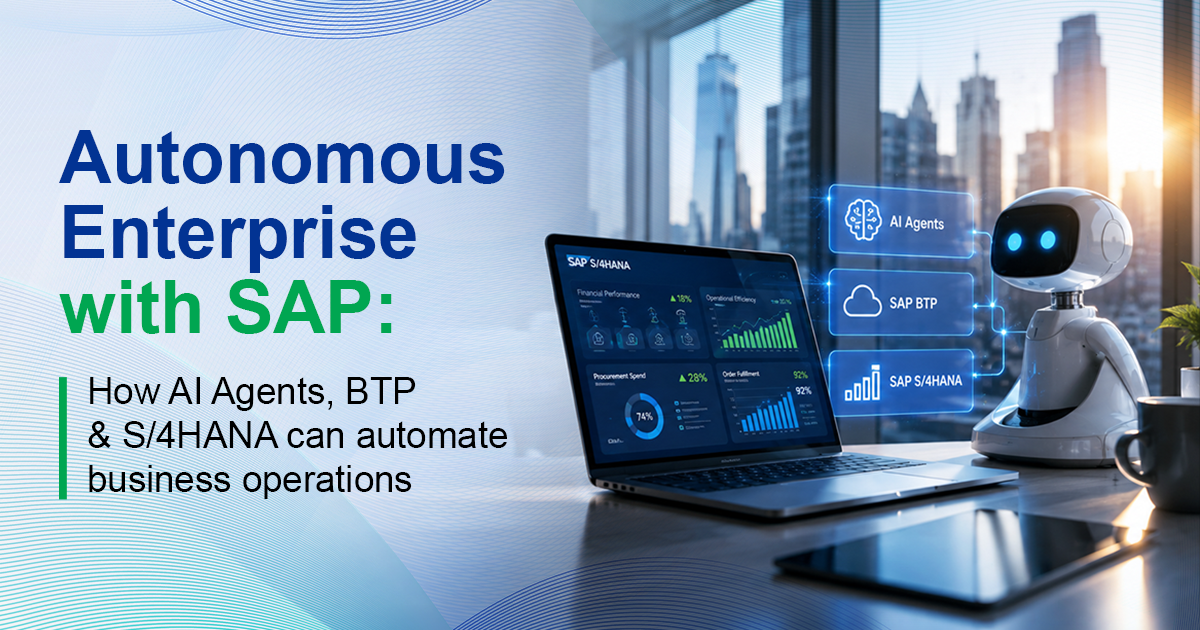
Autonomous Enterprise with SAP: How AI Agents, BTP and S/4HANA Can Automate Business Operations
- The Autonomous Enterprise represents a shift from traditional systems of record to intelligent systems of action, where AI agents help organisations execute workflows, make decisions, and improve operations.
- SAP S/4HANA, SAP BTP, and SAP Business AI work together to provide the data foundation, integration capabilities, and AI intelligence required to build scalable autonomous processes.
- Successful AI adoption depends on more than technology. Businesses need strong data quality, process readiness, governance, and the right implementation partner to unlock measurable business value.
Enterprise technology has traditionally been built around systems of record, platforms that capture transactions, store business data, and provide visibility into operations. ERP systems became the backbone of organisations by managing finance, procurement, supply chain, manufacturing, HR, and customer operations.
However, the next evolution of enterprise technology is moving beyond recording what happened to intelligently executing what needs to happen.
An autonomous enterprise works as an operating model for enterprise automation with SAP where AI agents work alongside people to execute workflows, analyse business situations, recommend decisions, and automate multi-step processes, while operating within defined business rules, security controls, and governance frameworks.
SAP’s vision of the Autonomous Enterprise brings together three critical components:
- SAP S/4HANA acts as the digital core that manages enterprise processes and trusted business data.
- SAP Business Technology Platform (BTP) provides the innovation and integration layer that connects applications, data, automation, and AI capabilities.
- AI agents powered by SAP Business AI and Joule bring intelligent entities that can reason,execute tasks, and orchestrate workflows across business functions.
Together, these capabilities enable organisations to move from isolated automation to intelligent, end-to-end business execution.
What Is an Autonomous Enterprise?
The Autonomous Enterprise is not about replacing people with AI. It is about creating a smarter way of working where humans focus on strategy, innovation, and decision-making, while AI agents handle repetitive tasks, analyse business situations, and execute workflows within defined business rules.
SAP defines the Autonomous Enterprise around three core principles:
1. Move Work Up the Value Chain
Many enterprise teams spend significant time managing repetitive operational activities such as invoice validation, purchase order follow-ups, data reconciliation, exception handling, and reporting. AI agents can automate these activities and reduce manual effort, allowing employees to focus on higher-value business decisions.
For example, in procurement, an AI agent can continuously monitor purchase orders, identify supplier delivery risks, analyse historical performance, recommend corrective actions, and trigger escalation workflows when required. Instead of teams spending time collecting information, they can focus on making faster and more informed decisions.
2. Run Operations in Real Time
Traditional businesses often rely on reports that explain what happened in the past. An autonomous enterprise shifts this approach by using real-time data and AI-driven insights to identify opportunities and risks as they happen.
With SAPS/4HANA’s real-time data foundation, businesses can proactively detect inventory shortages, identify financial anomalies, predict supply chain disruptions, and adjust operational plans based on changing business conditions. This enables organisations to move from reactive reporting to proactive execution.
3. Build with Control and Governance
Enterprise AI must operate with security, accountability, and governance. Unlike consumer AI tools, business AI requires strict controls around data access, user permissions, compliance, and process ownership.
SAP enables organisations to build, deploy, and manage AI agents on a governed foundation,ensuring that automation can scale while maintaining trust and control overcritical business operations.
The Autonomous Enterprise combines human expertise with AI-driven execution to create organisations that are more intelligent, agile, and responsive.
The Role of AI Agents in Enterprise Automation
Unlike traditional automation tools that follow predefined rules and execute specific tasks, AI agents can understand business context, analyse situations, make decisions, and take action across complex workflows.
Traditional automation follows predefined rules: If condition A happens → execute action B
AI agents go beyond this by combining data, process knowledge, and reasoning capabilities to achieve a business objective.
For example, in invoice processing, traditional automation can identify a mismatch between an invoice and purchase order and notify the finance team. An AI agent can go further, it can analyse the invoice details, review purchase history, validate business rules, check approval limits, determine whether the mismatch requires action, resolve the issue if permitted, or route it to the right stakeholder with relevant context.
Similarly, in supply chain operations, an AI agent can monitor inventory levels, detect potential shortages, analyse demand patterns, evaluate supplier availability,and recommend or trigger replenishment actions.
The key difference is that AI agents do not simply automate tasks; they enable intelligent execution. They help businesses move from rule-based automation to adaptive, context-aware operations where systems can respond faster, handle exceptions, and support better decision-making.
How SAP AI Agents Work Inside Enterprise Processes
SAP AI agents operate using three important capabilities:
1. Business Context Understanding
AI models alone do not understand enterprise operations. To make accurate decisions, AI agents need access to business context, including organisational structures, process rules, policies, historical decisions, data relationships, and industry-specific requirements.
SAP provides this context through its business applications, data models, and embedded process knowledge.
For example, a supply chain AI agent does not only analyse inventory levels. It understands current stock availability, supplier commitments, production schedules, customer demand, and procurement policies. This deeper understanding allows the agent to provide more accurate recommendations and take relevant actions.
2. Business Process Execution
SAP AI agents move beyond providing insights or recommendations. They can actively participate in business workflows and execute tasks based on defined rules and approvals.
In finance, AI agents can analyse journal entries, detect anomalies, support financial closing activities, identify payment risks, and automate reconciliation processes.
In procurement, they can evaluate supplier performance, recommend sourcing options, monitor contracts, and streamline approval workflows.
In supply chain, AI agents can predict shortages, trigger replenishment activities, monitor logistics exceptions, and optimise inventory decisions.
In human capital management, they can support employee on boarding, automate HR workflows, and assist workforce planning activities.
3. Enabling Multi-Agent Collaboration
The future of autonomous operations is not dependent on a single AI agent handling every task. Instead, specialised AI agents will collaborate to manage complex business scenarios.
For example, when a supply chain agent detects an increase in demand, it can coordinate with other agents — a planning agent to evaluate production requirements, a procurement agent to assess supplier availability, a finance agent to validate budget impact, and a logistics agent to optimise delivery plans.
This collaboration creates connected, intelligent business execution where multiple systems and processes work together with minimal manual intervention.
SAP S/4HANA: The Digital Core for Autonomous Operations
SAP S/4HANA provides the foundation required for autonomous enterprise capabilities. Unlike disconnected systems where AI has limited visibility, S/4HANA provides access to structured enterprise processes and real-time transactional data.
It supports core business functions including:
- Finance
- Procurement
- Manufacturing
- Supply Chain
- Sales
- Asset Management
- Service Operations
This connected process foundation is essential because AI agents require more than raw data,they need accurate business context to make meaningful decisions.
For example, an inventory AI agent cannot make effective decisions by looking only at stock levels. It also needs information such as material availability, supplier commitments, demand forecasts, production schedules, and procurement policies.SAP S/4HANA brings these data points together, enabling AI agents to understand the complete business scenario and recommend or execute the right actions.
SAP BTP: The Integration and Innovation Layer
While S/4HANA provides the business core, SAP Business Technology Platform enables organizations to extend, integrate, and innovate beyond the ERP core.
a.) Integration Across Enterprise Landscapes
Modern enterprises rarely operate only on SAP systems. They operate across diverse technology landscapes that include SAP applications, third-party platforms, cloud services, and legacy systems. SAP BTP enables AI agents to securely interact across these environments by connecting applications, data sources, APIs, and business workflows.
2.) Building Custom AI Applications
Businesses often require AI capabilities specific to their industry or processes. SAP BTP enables organisations to:
- Build custom applications
- Create extensions
- Develop AI workflows
- Connect enterprise data sources
This allows businesses to innovate faster while maintaining a clean and scalable ERP environment.
3.) Governance and Security
Enterprise AI requires control. SAP BTP provides capabilities such as identity management,application security, monitoring, integration governance, and life cycle management to ensure AI solutions operate securely and reliably at scale.
SAP Joule: The Human Interface for Enterprise AI
SAP Joule acts as the intelligent interaction layer between users, business applications, and AI capabilities. Instead of navigating multiple systems and manually searching for information, users can interact with enterprise processes through natural language.
Examples:
A finance leader can ask: “Show me the major risks affecting this month’s closing.”
A procurement manager can ask: “Which suppliers have delivery risks this quarter?”
A business user can request: “Create a report comparing inventory availability across regions.”
Joule understands business context and works with AI agents, applications, and workflows to provide relevant insights and execute actions. By bringing together conversational interaction, enterprise data, and AI-powered execution, Joule helps organisations make faster decisions and simplify everyday business operations.
The Future of Enterprise Operations
The autonomous enterprise represents a fundamental shift in how businesses operate. Future organisations will not simply use ERP systems to record transactions. They will use intelligent platforms that continuously analyse situations, recommend actions, and execute processes.
However, becoming an autonomous enterprise is not achieved by simply deploying AI tools. Organisations must first build the right foundation- clean and connected data,standardised processes, strong governance frameworks, and clearly defined business use cases where AI can deliver measurable impact.
Vestrics Solutions helps organisations prepare for and accelerate their SAP transformation journey — from SAP S/4HANA implementation and optimisation to SAP BTP integration, AI adoption, and intelligent automation. With deep SAP expertise and a business-first approach, or experts enables enterprises to build scalable, future-ready systems that are ready for the autonomous era. Book a consultation with us to learn more about enterprise automation with SAP.
FAQs
1. How should businesses identify the right processes for AI agent implementation?
Businesses should begin with processes that are high-volume, repetitive, rule-driven, and have measurable outcomes. Areas like finance operations, procurement workflows,customer service, and supply chain exceptions are often strong starting points.
2. How are AI agents different from AI chatbots used by businesses today?
AI chatbots primarily provide information or answer queries. AI agents can understand objectives, interact with enterprise systems, execute workflows, and complete multi-step tasks within defined business boundaries.
3. What role does data governance play in successful AI adoption?
Data governance ensures AI agents work with accurate, consistent, and trusted information. Strong governance around data ownership, quality, access, and compliance improves reliability and reduces operational risks.
4. Can organisations adopt AI agents without replacing their existing SAP landscape?
Yes. Organisations can extend existing SAP environments by integrating AI capabilities through SAP BTP, enabling intelligent workflows and automation without disrupting their current ERP investments.
5. What should businesses evaluate before starting their autonomous enterprise journey?
Businesses should assess ERP readiness, process maturity, data quality, integration landscape, security requirements, and priority use cases to create a practical roadmap for scalable AI adoption.


Fuel Your Business Transformation with Our Insights
Bookmark this page for regular updates and explore how our expertise can accelerate your
transformation journey.