.svg)


SAP Business AI in 2026: How Joule and AI Agents Are Changing Enterprise Operations

Key takeaways
· SAP Business AI is transforming ERP systems into conversational, intelligent operational environments that reduce manual navigation, accelerate workflows, and improve enterprise-wide decision-making.
· SAP Joule AI and specialized AI agents help automate finance, procurement, supply chain, and employee workflows by combining conversational interaction with agent-driven execution capabilities.
· The future of enterprise operations will depend on context-aware, predictive, and autonomous AI systems that reduce operational friction while enabling employees to focus on strategic work.
Enterprise systems were originally designed to standardize operations. However, over time, many organizations discovered that standardization alone does not guarantee efficiency. Large ERP environments often became operationally heavy. Employees had to navigate multiple interfaces, remember transaction codes, switch between dashboards, search for documents, validate data manually, and depend on technical teams for relatively simple tasks.
Despite years of digital transformation investments, many businesses continued facing common operational challenges. Approvals were delayed, workflows remained disconnected, data visibility was fragmented, and many processes still depended heavily on manual work. Artificial intelligence is now changing how enterprises interact with those systems.
The conversation around AI inside businesses has matured significantly by 2026. Organizations are no longer experimenting with AI only for drafting emails or generating summaries. Enterprise leaders are now reevaluating whether AI can directly reduce operational friction across finance, supply chain, procurement, HR, manufacturing, and customer operations.
Why SAP Business AI Is Becoming Central to Enterprise Operations
SAP’s AI strategy is not centered around standalone productivity tools. Instead, the company is embedding AI directly inside enterprise workflows, business applications, and operational processes.
SAP Joule AI, specialized SAP AI agents, and embedded AI capabilities across SAP solutions are collectively transforming ERP systems from static software environments into conversational and action-oriented operational platforms.
According to SAP’s Q1 2026 updates, Joule is now integrated across 35 SAP solutions, supported by more than 30 specialized AI agents and over 2,500 Joule Skills. The scale itself reflects a larger industry direction. Enterprise AI is moving from isolated experimentation to operational infrastructure.
The significance of this shift becomes clearer when viewed from the perspective of day-to-day enterprise operations. Employees rarely work in imperfectly structured workflows. Finance teams manage invoice disputes, procurement teams negotiate sourcing changes, supply chain planners react to inventory volatility, HR teams resolve employee policy requests, and operations managers continuously deal with exceptions.
Much of enterprise work involves navigating ambiguity, context switching, and repetitive administrative actions. SAP Business AI is designed to reduce that operational burden.
Enterprise AI Is Moving Beyond Automation
Traditional enterprise automation focused primarily on rules-based execution. Systems could automate predefined workflows, but they struggled when users needed contextual reasoning, natural interaction, or adaptive decision-making.
This limitation created a gap between enterprise software and real human workflows. Employees still spent large portions of their day searching for information, validating documents, escalating issues, or coordinating between disconnected systems.
Modern enterprise AI attempts to close that gap by introducing conversational interaction, contextual intelligence, and autonomous execution capabilities into operational systems themselves.
SAP’s current approach operates through two connected layers:
· SAP Joule as the conversational interface
· SAP AI agents as the execution and orchestration layer
Joule acts as the interface through which users interact naturally with enterprise systems. AI agents operate behind the scenes, executing specialized operational tasks, retrieving contextual information, automating workflows, and coordinating actions across applications.
Together, they create an environment where employees can move from asking questions to completing business tasks without constantly navigating multiple systems manually.
This fundamentally changes how ERP environments operate. Instead of employees adapting themselves to rigid enterprise software structures, software increasingly adapts to human intent, language, and workflow patterns.
Must read: SAP Joule and the Future of Intelligent Workflows
How SAP Joule Changes User Interaction with ERP Systems
One of the biggest operational inefficiencies inside enterprises comes from system navigation complexity. Employees often know what they want to achieve but struggle with how to execute it within enterprise software.
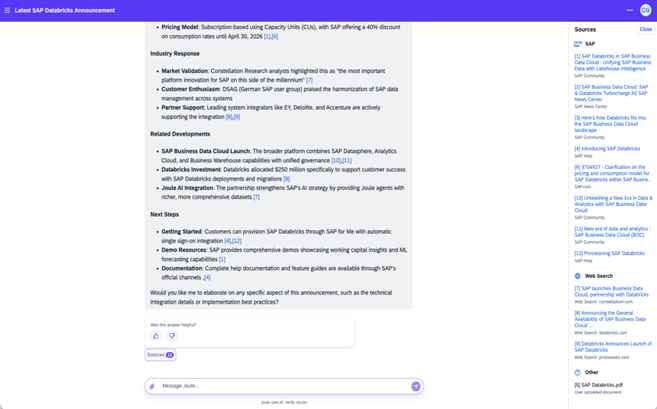
SAP Joule AI addresses this problem by functioning as a conversational assistant embedded directly inside SAP applications. Users can ask questions in natural language, retrieve business context, analyze operational information, and execute supported tasks directly from the interaction layer itself.
Why Traditional ERP Navigation Creates Friction
In large organizations, even routine actions can involve multiple applications, approvals, data repositories, and workflow dependencies. Employees may need to:
· Search for invoices and payment records
· Compare procurement agreements and supplier terms
· Validate contracts and compliance documents
· Analyze supply chain disruptions and inventory exceptions
· Retrieve HR policies or operational guidelines
· Coordinate approvals across departments
Traditionally, this required navigating through several systems manually. Joule reduces that navigation burden by translating user intent into executable operational actions.
Conversational Access to Enterprise Intelligence
Inside SAP Datasphere, for example, users can ask analytical questions conversationally, retrieve grounded answers, and perform workflow-related actions directly from the conversation layer. Instead of memorizing technical pathways or depending on specialized reporting teams, business users can interact with enterprise data more naturally.
This represents a major shift in how organizations consume ERP intelligence. Enterprise systems historically required employees to learn software logic. Conversational AI reverses that model by allowing software to interpret human intent.
The operational impact becomes particularly visible in environments where employees handle large volumes of repetitive information retrieval tasks. SAP reports that:
· Joule inside SAP Intelligent Clinical Supply Management information search time by 83%
· Joule in SAP Signavio reduces information discovery time by 50%
Those improvements are not merely productivity enhancements. They directly affect operational responsiveness, compliance speed, and decision quality.
Grounded AI Responses and Enterprise Trust
SAP Joule for Consultants introduces another important enterprise capability: grounded responses with citations. Users can upload multiple PDF and TXT files directly into conversations, enabling the assistant to work with customer-specific documentation, implementation materials, or operational records.
In enterprise environments, this grounded AI approach is essential because organizations cannot rely on unverified generative outputs when dealing with finance, procurement, compliance, or operational data.
SAP AI Agents Are Bringing Agentic Execution Into Enterprise Operations
As enterprise workflows become more complex, organizations are realizing that conversational AI alone is not enough. Employees may receive insights or recommendations from AI, but operational bottlenecks still remain if systems cannot independently coordinate actions, validate information, and execute multi-step processes.
SAP’s AI agents are designed specifically for enterprise processes. Rather than acting as general-purpose assistants, these agents focus on specialized operational functions such as dispute resolution, project setup, catalog optimization, expense validation, tender analysis, and planning support.
While Joule handles conversational interaction, SAP AI agents manage execution-oriented operational tasks. The enterprise value of these agents comes from their ability to reduce repetitive operational overhead while improving execution consistency.
Finance Operations Are Becoming More Autonomous
Finance departments continue to face intense operational pressure around accuracy, compliance, speed, and working capital optimization. Invoice disputes, payment reconciliation, approval delays, and manual validation processes often consume enormous amounts of operational time.
SAP’s Dispute Resolution Agent addresses one of the most resource-intensive areas within finance operations. The agent analyzes invoices, sales orders, delivery records, pricing agreements, and tax rules to identify root causes behind disputes automatically.
Instead of finance teams manually reviewing fragmented records across systems, the AI agent accelerates investigation and resolution cycles.
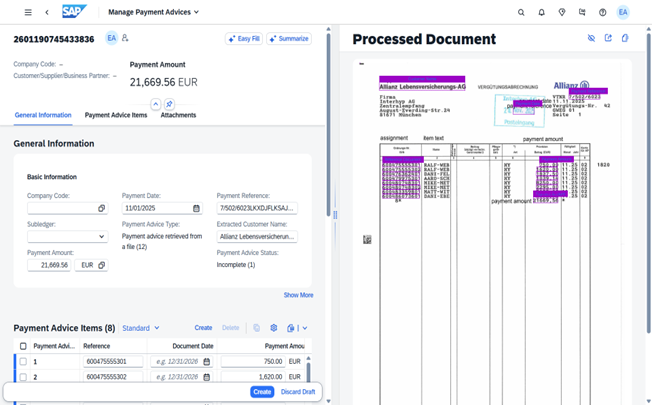
The impact of AI becomes even more visible in document-heavy finance workflows. SAP Document AI capabilities for payment advice processing reportedly reduce document processing time by 70%, reduce template maintenance effort by 83%, and lower value loss caused by manual delays by 40%.
These improvements directly influence:
· Cash flow velocity
· Accounts receivable efficiency
· Financial accuracy
· Operational scalability
· Exception management speed
Finance transformation is increasingly becoming less about digitizing records and more about reducing cognitive workload across financial operations.
SAP Business AI supports that transition by embedding contextual intelligence directly into financial workflows rather than isolating AI separately from ERP execution.
Supply Chain Operations Require Real-Time Intelligence
Supply chain environments are highly dynamic. Inventory variability, demand fluctuations, supplier disruptions, logistics bottlenecks, and operational exceptions require continuous decision-making.
Traditional ERP systems provided visibility but often lacked adaptive operational intelligence. SAP AI agents are now being integrated into supply chain planning and execution environments to improve responsiveness and operational precision.
The Project Setup Agent, for example, helps organizations establish projects using historical operational context from previous initiatives. SAP reports measurable reductions in project creation time, faster resource allocation, and lower rework caused by incorrect project templates.
Inside SAP Integrated Business Planning, AI-assisted MRO inventory analysis reduces the time required for analyzing inventory runs by approximately 30%.
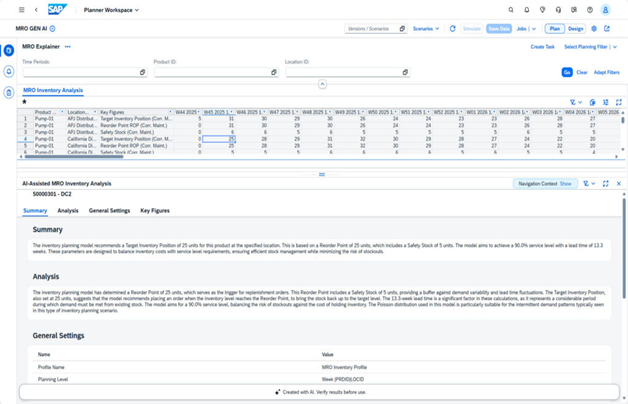
This type of operational AI is particularly important because supply chain planning increasingly depends on handling large volumes of variable operational data. Enterprises can respond faster because AI reduces the time employees spend interpreting operational signals manually.
Procurement and Commercial Operations Are Becoming More Contextual
Procurement workflows involve large volumes of documentation, vendor coordination, contract analysis, compliance validation, and sourcing decisions.
Manual execution across these processes introduces delays and increases operational risk. SAP’s procurement-focused AI capabilities are designed to reduce those inefficiencies.
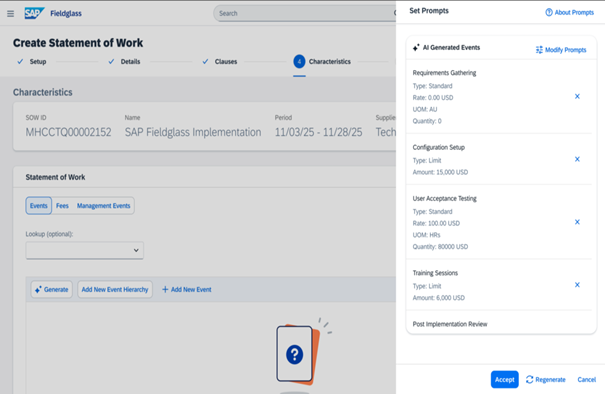
SAP Fieldglass Services Procurement reportedly reduces manual statement-of-work deliverable creation by 70% while lowering poor-outcome risks significantly.
Similarly, catalog optimization agents reduce the operational burden associated with catalog translation, enrichment, and description management.
Commercial teams also benefit from AI-assisted tender analysis capabilities. Tender evaluation often requires reviewing large amounts ofprocurement documentation, technical requirements, pricing structures, and qualification criteria. SAP’s Tender Analysis Agent helps reduce effort associated with processing incoming tenders while improving operational responsiveness.
The Future Enterprise Operations Is Becoming Agent-Driven
Enterprise AI is rapidly moving beyond experimentation and becoming part of the operational core of modern businesses. By 2026, AI is no longer functioning as an external productivity layer added on top of enterprise systems. It is becoming deeply embedded inside ERP platforms, business workflows, operational decision-making environments, and cross-functional execution processes.
For businesses evaluating how SAP Business AI, SAP Joule, and AI agents can fit into their enterprise transformation roadmap, implementation strategy becomes critical. Successfully integrating AI into ERP operations requires the right architecture, workflow alignment, governance controls, and business process understanding.
At Vestrics Solutions Pvt. Ltd., we help organizations understand, implement, and optimize SAP-driven transformation initiatives across ERP modernization, SAP Business AI adoption, enterprise automation, analytics, and intelligent business operations.
To explore how SAP Business AI and agent-driven enterprise workflows can support your operational goals, performance optimization, and digital transformation strategy, schedule a consultation with us.
FAQs
1. What is SAP Business AI in 2026?
SAP Business AI is SAP’s enterprise AI layer that combines conversational assistance, automation, and agentic workflows to improve business operations across ERP and connected applications.
2. How does SAP Joule work?
SAP Joule works as a natural language interface that helps users ask questions, retrieve context, navigate systems, and execute tasks inside SAP applications without complex menu navigation.
3. What are SAP AI agents used for?
SAP AI agents handle specific business tasks such as tender analysis, project setup, dispute resolution, expense validation, catalog optimization, and planning support across enterprise workflows.
4. How is SAP Business AI useful in finance and supply chain?
In finance and supply chain, SAP Business AI helps reduce manual processing, improve dispute resolution, speed up project setup, enhance inventory analysis, and support faster decision-making.
5. Why is SAP Business AI important for enterprise operations?
It is important because it reduces repetitive work, improves accuracy, strengthens governance, and helps teams complete operational tasks faster with less manual effort.
Recommended Blogs

Fuel Your Business Transformation with Our Insights
Bookmark this page for regular updates and explore how our expertise can accelerate your
transformation journey.