.svg)


SAP Business Data Cloud for AI: Building an AI-Ready ERP
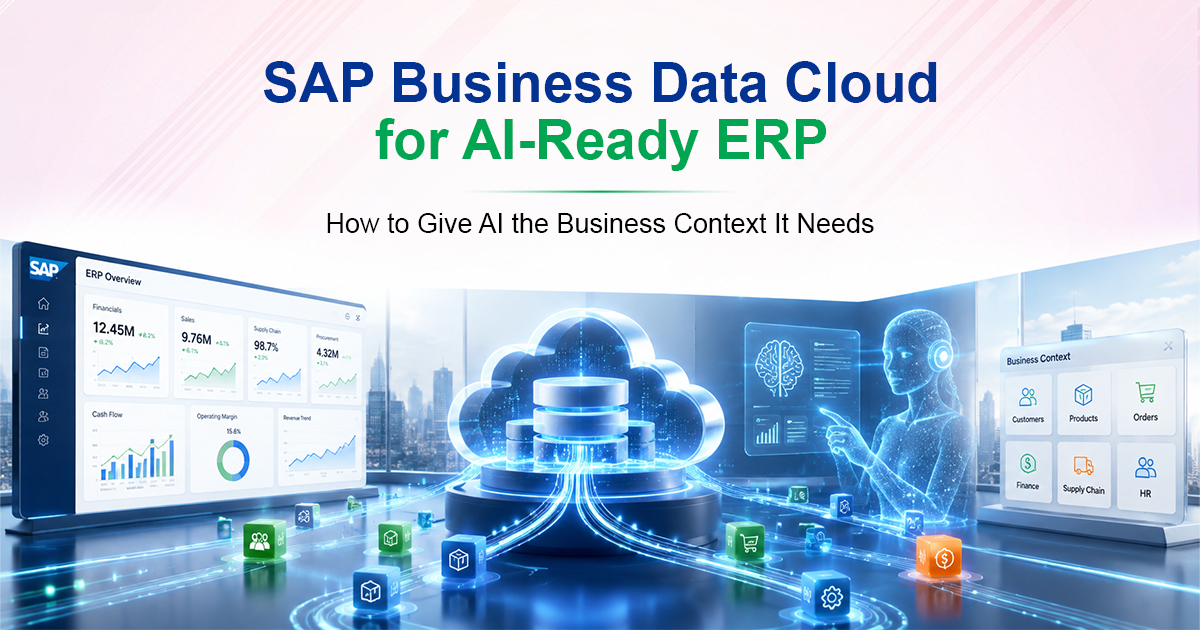
SAP Business Data Cloud for AI-Ready ERP: How to Give AI the Business Context It Needs
- ERP data becomes more valuable when AI can understand its meaning, relationships, processes, permissions, and governance requirements.
- SAP Business Data Cloud creates an AI-ready foundation. It combines governed data products, SAP Data sphere, SAP Knowledge Graph, SAP Databricks, and SAP HANA Cloud to support reliable analytics and AI agents.
- Vestrics Solutions Pvt. Ltd. helps enterprises assess readiness, integrate data, modernize SAP environments, establish governance, and implement scalable, business-focused AI use cases.
Artificial intelligence is rapidly becoming an important part of enterprise resource planning. Organizations are increasingly using copilots, predictive models,intelligent agents, and automated decision-support tools across finance,procurement, supply chain, human resources, and customer operations. These technologies can improve efficiency, accelerate analysis, and support faster decision-making.
However, simply connecting an AI model to ERP data does not make an organization AI-ready. An AI system may be able to retrieve a purchase-order value, inventory level, customer balance, or general-ledger entry. But without understanding what that data means, how it relates to other business objects, and which policies govern its use, the system may produce incomplete, misleading, or operationally risky outputs.
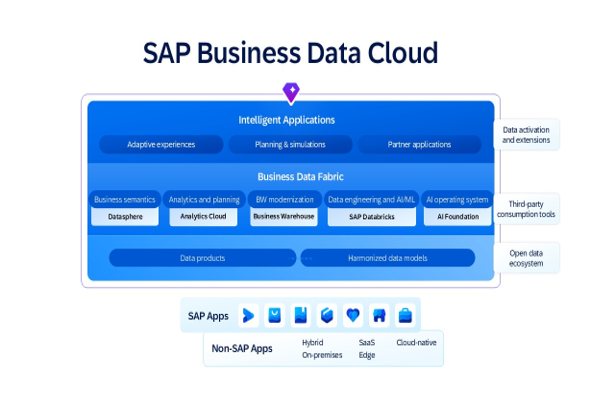
SAP Business Data Cloud is designed to address this situation. It brings together governed SAP and non-SAP data, semantic models, reusable data products, analytics, data engineering, and AI capabilities within a unified environment. By preserving business definitions, relationships, and context, the platform helps intelligent applications and AI agents work with information they can interpret more accurately.
Why ERP Data Alone Is Not Enough for Enterprise AI
ERP systems contain valuable operational data, including sales orders, invoices, payments,inventory movements, production records, employee information, maintenance activities, and supplier transactions. However, raw ERP data alone does not provide the full context AI needs to generate reliable business insights.
When ERP field sare transferred into a data warehouse, data lake, or machine-learning environment, their original meaning and relationships may be lost. Technical labels such as [MATNR], [BUKRS], and [KOSTL] identify fields, but they do not explain that these represent materials, company codes, or cost centres.
AI must also understand how these objects connect with plants, suppliers, customers, accounts, contracts, and business policies. This becomes more complex when data comes from multiple SAP and non-SAP systems.
Without shared definitions, governance, and semantic consistency, concepts such as revenue, inventory, margin, or supplier risk may differ across departments. As a result, AI can produce plausible answers that are inaccurate or commercially misleading.
What Business Context Means in an ERP Environment
Business context explains what enterprise data means, how different records are connected, where they sit within a business process, and which rules control their use. This context helps AI interpret ERP information accurately rather than treating it as isolated values.
It typically includes several layers.
1.) Business Semantics
Semantics explain what the data represents. A numeric value of [250,000] has little meaning on its own. It becomes useful only when the system knows whether it represents revenue, purchase value, planned cost, outstanding receivables, available budget, or inventory valuation.
Semantics may also define currency, unit of measure, fiscal period, source system,calculation logic, and ownership details.
2.) Entity Relationships
Enterprise decisions rarely involve one data object in isolation. A sales order may be related to a customer, product, distribution channel, plant, delivery, invoice, payment status, and profitability segment. A supplier may be connected to contracts, purchase orders, quality records, delivery performance, regulatory classifications, and production dependencies.
These relationships allow AI systems to trace how an event in one part of the business could affect another.
3.) Process Context
ERP data is generated through business processes. An invoice, for example, may be part of an order-to-cash process. A purchase requisition belongs to a procure-to-pay process. A maintenance order may be part of an asset-management process.
Understanding the process stage helps AI distinguish between events that may look similar at the database level but require different actions.
4.) Governance and Authorization Context
Not every user,application, or AI agent should be allowed to access every data object or execute every action.
Business context must therefore include:
- Data-access rights
- User roles
- Segregation-of-duties controls
- Data residency requirements
- Retention policies
- Approval thresholds
- Audit requirements
- Industry-specific compliance rules
This layer becomes especially important as AI progresses from answering questions to initiating or executing business transactions.
What Is SAP Business Data Cloud?
SAP Business Data Cloud, commonly abbreviated as SAP BDC, is a managed data and analytics environment that unifies and governs SAP and third-party data.
The platform combines capabilities associated with SAP Data sphere, SAP Analytics Cloud, SAP Business Warehouse modernization, SAP Data bricks, data products, intelligent applications, and SAP’s business semantics.
Its role is not simply to consolidate data into another central repository. SAP Business Data Cloud is intended to preserve and expose the context attached to mission-critical enterprise data.
SAP-delivered data products can make information from processes such as finance, procurement, supply chain, workforce management, and spend management available in a governed and reusable form. These products retain business definitions and semantics rather than providing only raw technical tables.
How SAP Business Data Cloud Gives AI Business Context
1. Curated data products retain business meaning
A data product is a managed, reusable package of data designed for a defined business purpose. Instead of requiring every analytics or AI team to extract SAP tables and reconstruct their meaning, SAP Business Data Cloud provides access to curated data products aligned with business processes.
A financial data product, for example, may include governed information about general-ledger accounts, cost centres, profit centres, organizational entities, and fiscal periods. A supply-chain data product may represent materials, locations,inventory positions, orders, suppliers, and fulfilment dependencies.
Because the definitions and relationships are retained, teams spend less time reverse-engineering ERP structures and reconciling competing interpretations.
SAP states that its managed data products are intended to reduce the expense and complexity associated with extracting and replicating operational data while preserving the data’s original business context.
2. SAP Data sphere provides the semantic layer
SAP Data sphere plays a central role in integrating, modelling, and governing enterprise information within the business data fabric.
It enables organizations to connect SAP and non-SAP sources while maintaining business definitions, relationships, metadata, and access controls. SAP Business Data Cloud can also make intelligent content and data products available through SAP Data sphere for further modelling and consumption.
This semantic layer is important because AI systems need stable definitions.
Consider a request such as: “Which customers are at risk of delayed delivery, and what is the expected revenue impact?”
Answering this reliably may require data from sales orders, delivery schedules, available-to-promise calculations, warehouse operations, transportation systems, customer prioritization rules, and financial forecasts.
The semantic layer helps establish how these objects are defined and connected. Without it,an AI application may retrieve relevant records but join or interpret them incorrectly.
3. SAP Knowledge Graph represents enterprise relationships
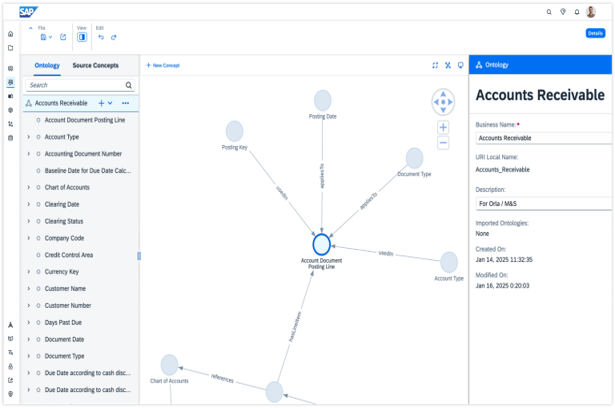
SAP Knowledge Graph connects business data, metadata, processes, and their relationships so that AI systems can reason with more than isolated fields.
SAP describes its knowledge-graph capabilities as a grounding mechanism for Joule, AI services,and large language models, helping them understand enterprise information within the context of its relationships.
This grounding can also improve natural-language interaction. A business user may ask about“high-risk suppliers,” even though no single database column carries that exact label. The knowledge graph and semantic models can help the system interpret the concept using delivery performance, quality issues, financial exposure, geographic dependencies, and other relevant information.
4. SAP Data bricks supports advanced data engineering and AI
SAP Data bricks brings Databricks data-engineering, data-science, machine-learning, and AI capabilities into the SAP Business Data Cloud environment.
Data teams can use it to combine contextual SAP information with third-party and unstructured datasets, develop machine-learning models, and operationalize analytical workloads without treating SAP data as an isolated source.
Model outputs can also be incorporated into custom data products and combined with standard SAP data products in SAP Datasphere. SAP documentation describes this pattern as away of enriching business data with machine-learning results.
This creates a closed analytical loop:
- Governed ERP data is provided to the model.
- The model generates a prediction or classification.
- The output is returned as a governed data product.
- Business applications, analytics, planning tools, or AI agents consume the result.
- Decisions and resulting transactions generate additional operational data.
5. SAP HANA Cloud supports transactional, analytical, graph, and vector workloads
SAP has expanded the role of SAP HANA Cloud within SAP Business Data Cloud, positioning it as a core database engine for AI and data workloads.
Its multi model capabilities can support relational, graph, spatial, and vector processing.This matters for enterprise AI because different reasoning tasks may require different types of retrieval.
An agent investigating a supply-chain disruption might need to:
- Query transactional records
- Traverse supplier and product relationships
- Perform vector-based semantic retrieval
- Evaluate geographic exposure
- Calculate operational and financial impacts
Supporting these workloads within a governed architecture can reduce the need to move data between multiple specialized platforms. SAP’s 2026 product direction also describes SAP Business Data Cloud as the data foundation supporting broader business AI and autonomous-enterprise scenarios.
From ERP Copilots to AI Agents
The need for business context becomes even greater when an AI system is allowed to act. A copilot may summarize overdue receivables. An agent may go further by identifying customers, prioritizing collection cases, drafting communications,proposing payment plans, and initiating workflows.
But for an agent to operate safely, it must understand:
- The user’s authority
- The company’s collection policy
- Customer classifications
- Contractual conditions
- Disputed invoice status
- Credit exposure
- Approval thresholds
- Regional legal requirements
- When human intervention is mandatory
The same principle applies to procurement, human resources, production, and finance.
An autonomous procurement agent should not select a supplier solely because it offered the lowest price. It may also need to consider quality history, contractual commitments, sustainability requirements, geopolitical exposure, delivery reliability, approved-vendor status, and production criticality.
SAP’s AI-native architecture connects governed data in SAP Business Data Cloud with semantic grounding through SAP Knowledge Graph. SAP describes this combination as the foundation that enables AI agents to reason and act using context-rich enterprise information.
Build an AI-Ready ERP Foundation with Vestrics Solutions
Enterprise AI cannot deliver reliable outcomes through raw ERP data alone. It requires governed information, consistent business semantics, clear data relationships,trusted lineage, and appropriate authorization controls. SAP Business Data Cloud provides this foundation by connecting SAP and non-SAP data while preserving the business context required by analytics, copilots,machine-learning models, and AI agents.
However,achieving an AI-ready ERP environment requires more than deploying a technology platform. Enterprises must assess their existing data landscape, modernize legacy architectures, resolve data-quality issues, establish governance, design reusable data models, and connect AI use cases with measurable business outcomes.
Vestrics Solutions Pvt. Ltd. can support organizations throughout this transformation. As an SAP Gold Partner, Vestrics offers expertise across SAP S/4HANA Cloud, SAP Business Technology Platform, SAP HANA Cloud, SAP Analytics Cloud, integration, and AI and machine-learning consulting.
By combining SAP implementation experience with data, integration, analytics, and AI capabilities, we help businesses move beyond fragmented data and isolated AI experiments. The result is a trusted, scalable foundation through which AI can understand enterprise operations, generate context-aware insights, and support more intelligent ERP processes.
Partner with Vestrics Solutions Pvt. Ltd. to build an AI-ready ERP ecosystem powered by trusted business data, governed intelligence, and SAP Business Data Cloud.
FAQs
1. Does SAP Business Data Cloud replace SAP BW (Business Warehouse)?
No. It supports BW modernization and integration while allowing organizations to retain relevant investments, expose governed data products, and gradually adopt newer cloud-based data and analytics architectures.
2. Can SAP Business Data Cloud work with non-SAP applications?
Yes. It can connect SAP data with information from third-party platforms, data lakes,warehouses, operational systems, and external sources to support cross-enterprise analytics and AI use cases.
3. Is SAP Business Data Cloud suitable for regulated industries?
It can support regulated environments through governance, lineage, access controls, and policy enforcement. However, organizations must still configure controls according to applicable industry, regional, and data-residency requirements.
4. What skills are needed to implement SAP Business Data Cloud?
Implementation typically requires expertise in SAP data architecture, Datasphere, BW, data engineering, security, governance, semantic modelling, analytics, and AI,supported by strong business-process knowledge.
5. How can enterprises measure the value of SAP Business Data Cloud?
Enterprises can track reduced data-preparation time, faster AI deployment, improved data quality, fewer reporting inconsistencies, better decision accuracy, lower integration costs, and measurable process improvements.


Fuel Your Business Transformation with Our Insights
Bookmark this page for regular updates and explore how our expertise can accelerate your
transformation journey.